The tutorial is scheduled for June 17, 2026, from 9:00 AM to 12:30 PM PT. It will be held in Ginsburg Auditorium.
Overview
As autonomous systems transition from controlled laboratory settings to real-world environments, a central challenge is to synthesize policies that are simultaneously generalizable, performant, and provably safe. This tutorial provides a methodological tour of this landscape through the lens of robotics, traversing from theoretical foundations to structured learning-based control, and ultimately to the emerging paradigm for scalable autonomy.
We begin by addressing the “what works” question in modern robotics, introducing the theoretical foundations for deployable, safe decision-making. We explore how frameworks such as control barrier functions (CBFs), control Lyapunov functions (CLFs), and predictive safety filters can enforce the regularities necessary to guide efficient learning and provide rigorous guarantees. After introducing the theoretical frameworks, we dive into the challenge of embedding these safety-critical principles into modern learning methods, such as deep reinforcement learning, diffusion models, and robot foundation models. In the second part, we explore learning in the presence of stochastic uncertainties, examining how different learning paradigms can be leveraged to enhance the performance of classical control methods. In the final part, we further highlight recent advances in perceptive methods, demonstrating how constraints can be distilled from high-dimensional sensory data to enforce geometric safety constraints (e.g., collision avoidance) as well as semantic safety constraints that extend beyond traditional definitions.
To conclude the tutorial, we present a holistic view and a set of tools to compare control-oriented and learning-oriented methods across six critical axes: model complexity, learning complexity, runtime, performance, robustness, and task generalization. This empirical foundation allows us to systematically quantify the trade-offs between structured decision-making methods and their flexible learning-oriented counterparts. By sharing these emperical results alongside theoretical and algorithmic tools, we aim to establish a common ground for further interdisciplinary discussions, paving the way to advance reliable and capable robot autonomy for future “in-the-wild” applications.
Program
09:00 – 09:20 Opening Remarks, Overview, and Introduction by Aaron D. Ames
09:20 – 10:00 Part I Control → Learning by Zachary Olkin and Mahathi Anand
10:00 – 10:20 Part II Learning → Control by Ryan K. Cosner
10:30 – 11:00 Coffee Break
11:00 – 11:20 Part II Learning → Control (Cont’d) by Lukas Brunke
11:20 – 12:00 Part III Perception-Based Methods by Ryan K. Cosner and SiQi Zhou
12:00 – 12:20 Summary, Outlook, and Discussion by Angela P. Schoellig
Organizers and Contributors
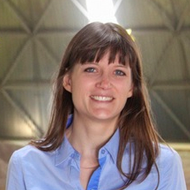
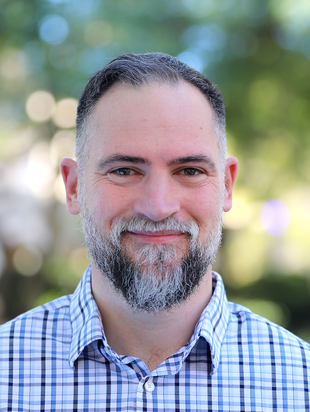
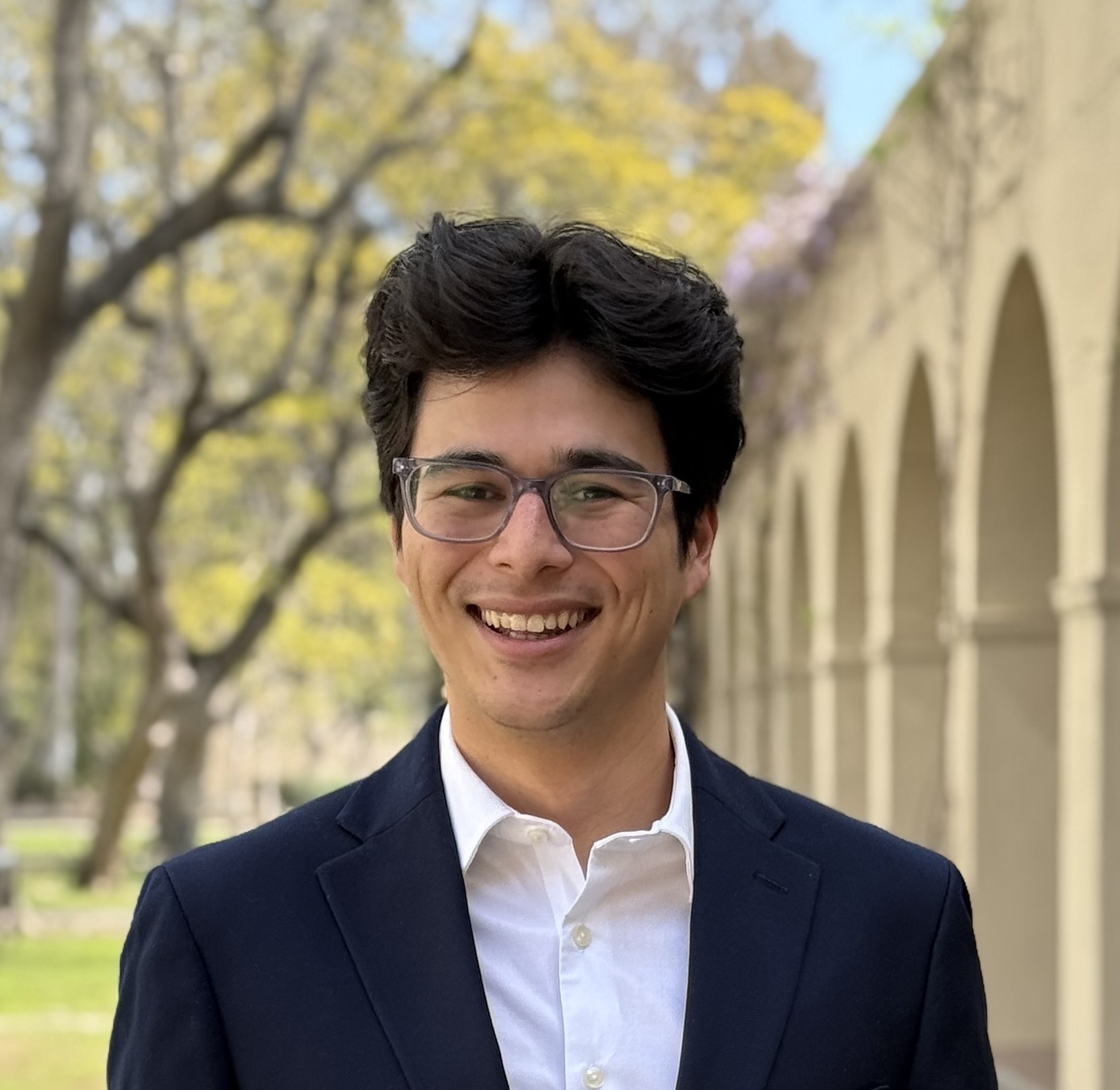






Open-Source Materials
Control for Robotics
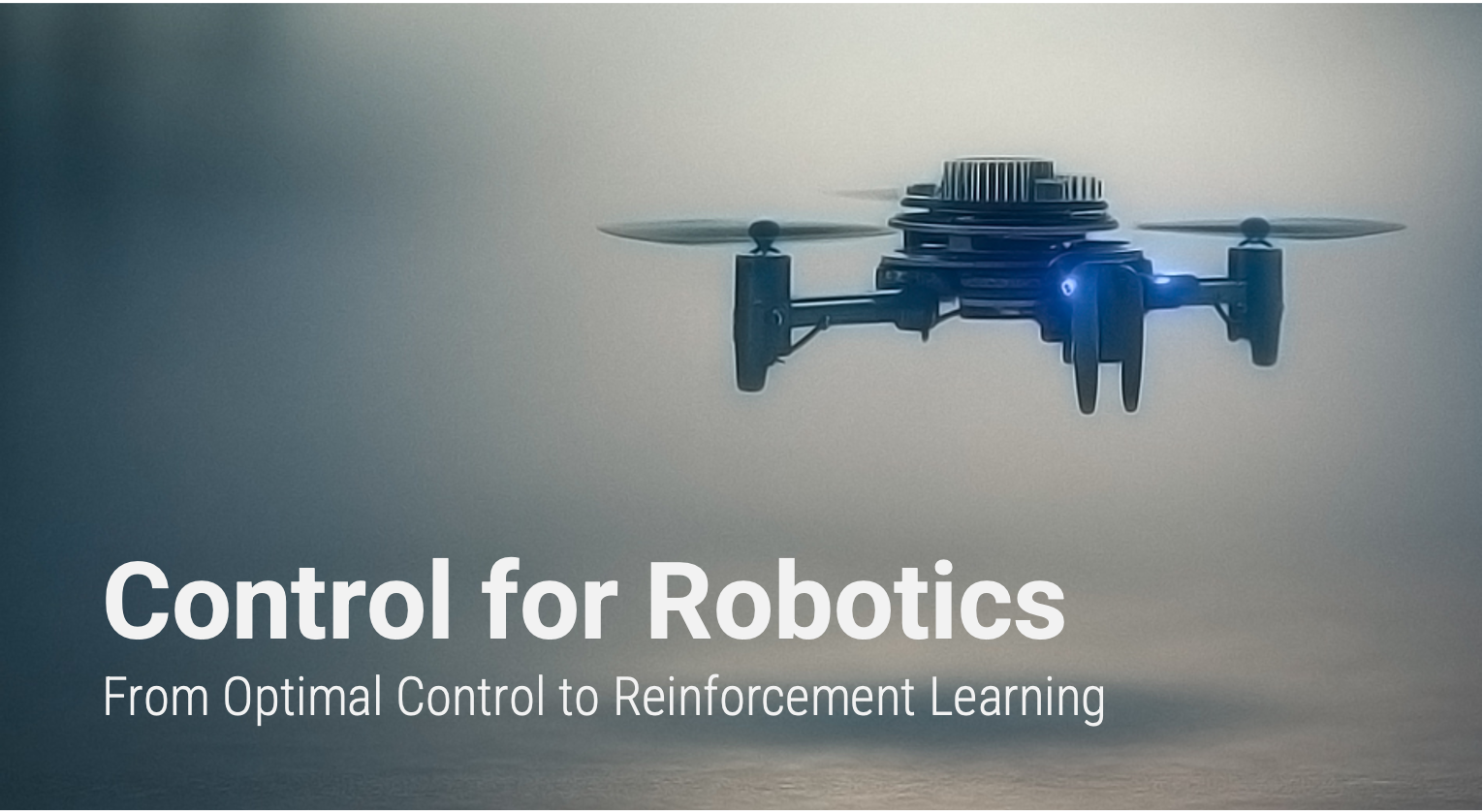
Overview: “Control for Robotics” is a three-course series, taking you on a journey from the foundations of optimal control all the way to deep reinforcement learning, with robot decision-making as the central theme. We begin by introducing key theoretical concepts with interactive code examples for each core algorithm to establish a clear connection between mathematical principles and their practical implementations. A set of programming exercises and a real-world drone challenge then provide hands-on experience in applying these methods to both simulated and physical robotic systems. Through this progression, whether you are a student or a practitioner, you will develop the skills to design controllers for complex, real-world robots.
Safe Control Gym
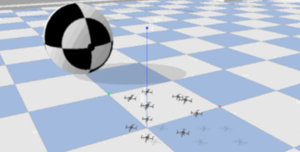
Overview: In recent years, reinforcement learning and learning-based control—as well as the study of their safety, crucial for deployment in real-world robots—have gained significant traction. However, to adequately gauge the progress and applicability of new results, we need the tools to equitably compare the approaches proposed by the controls and reinforcement learning communities. Here, we propose a new open-source benchmark suite, called safe-control-gym. Our starting point is OpenAI’s Gym API, which is one of the de facto standard in reinforcement learning research. Yet, we highlight the reasons for its limited appeal to control theory researchers—and safe control, in particular. E.g., the lack of analytical models and constraint specifications. Thus, we propose to extend this API with (i) the ability to specify (and query) symbolic models and constraints and (ii) introduce simulated disturbances in the control inputs, measurements, and inertial properties. We provide implementations for three dynamic systems—the cart-pole, 1D, and 2D quadrotor—and two control tasks—stabilization and trajectory tracking. To demonstrate our proposal—and in an attempt to bring research communities closer together—we show how to use safe-control-gym to quantitatively compare the control performance, data efficiency, and safety of multiple approaches from the areas of traditional control, learning-based control, and reinforcement learning.
Crazyflow
Overview: Crazyflow is a drone simulator designed to push the limits of aerial-robotics algorithm development. The software well-supports different policy synthesis paradigms, including but not limited to analytical-gradient-based policy learning and sampling-based model predicitive approaches. Notably, its speed, accuracy, and differentiability together allow us to train high-performance RL agents in subseconds and transfer to real system without domain randomization. Crazyflow serves as an open-source resource for synthetic data generation, with emerging capabilities for large-scale parallelization for online, in-execution learning and optimization, opening the door to novel algorithm development.
Stay Connected!
Join our mailing list and safe-robot-learning Google group to stay connected!